
Key takeaways
Size from your day, not the brochure: required rate = daily output ÷ (production hours × efficiency). 6,000 loaves in a 6-hour window at 85% efficiency needs about 1,180 loaves an hour of rated capacity.
The divider is rarely the bottleneck: proving, baking and cooling have fixed dwell times. At 1,200 loaves an hour with a 55-minute final proof, the prover must hold about 1,100 loaves at once.
Semi-automatic suits up to roughly 2,400 pieces an hour per divider and keeps people at loading, panning and oven transfer. Full automation pays when labour, not dough, is your constraint.
2026 labour maths: award wages rose 4.75% on 1 July 2026 and super is 12%. If two operator positions are genuinely removed from every 8-hour shift, that saves roughly A$170,000 to A$190,000 a year at A$42 to A$48 an hour loaded cost.
Match the make-up method to the dough: piston and vacuum dividers suit standard tin dough; sheeting ("stress-free") systems handle high-hydration artisan doughs without knocking out the gas.
Most bakeries that end up with the wrong line chose it on rated speed. Size it instead from three numbers: how much you make a day, the hours you have to make it, and the slowest stage in the line.
Step 1: Work out the hourly rate you actually need
\text{Required rated capacity} = \frac{\text{Daily output}}{\text{Production hours} \times \text{Line efficiency}}
Daily output | Production window | Planning efficiency | Required rated capacity |
|---|---|---|---|
2,000 rolls | 4 hours | 80% | 625 pieces/hour |
6,000 loaves | 6 hours | 85% | 1,180 loaves/hour |
10,000 loaves | 8 hours | 85% | 1,470 loaves/hour |
20,000 loaves | Two 7-hour shifts | 85% | 1,680 loaves/hour |
The production window is set by dispatch, not by the clock: bread has to be baked, cooled and packed before the trucks leave. Efficiency covers start-up, changeovers, cleaning and short stops. 80% to 85% is a reasonable planning assumption until a supplier can show data from a comparable site.
Step 2: Check the capacity of every stage
Each stage holds product for a fixed time, so the amount it must hold equals the line rate multiplied by that time. Using example dwell times for a 1,200 loaves/hour tin bread line (substitute your own recipe's):
Stage | Example dwell time | Loaves the stage must hold |
|---|---|---|
Final prover | 55 minutes | 1,100 |
Oven | 30 minutes | 600 |
Cooling | 90 minutes | 1,800 |
This is why a new make-up line bolted onto an existing rack or deck oven often runs at the oven's pace, not its own. Work out what each existing stage can process per hour before you specify anything upstream of it.
Ask suppliers for the rate at your piece weight, not the brochure maximum. Rated ranges are wide: Rondo's ASTec baguette line, for example, covers 500 to 5,000 kg of dough an hour across piece weights from 25 g to 4,500 g.
Step 3: Choose the automation level
Level | Typical output | Where people still work | Best fit |
|---|---|---|---|
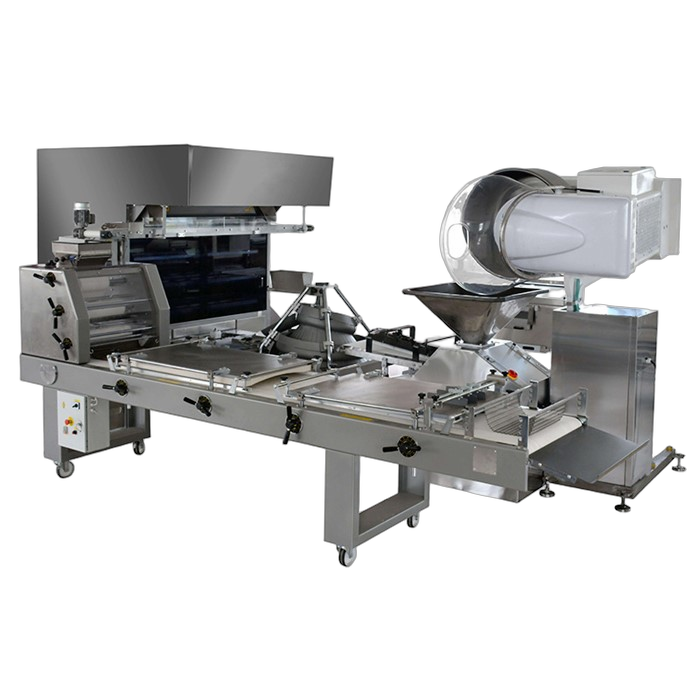
Semi-automatic make-up group | Up to about 2,400 pieces/hour from a single-piston divider; optional moulder stations can multiply this two to five times | Loading dough, panning, prover and oven transfer, unloading | Artisan wholesalers, central kitchens for retail chains, one or two product families |
Automated make-up line with panning | Depends on rows and piece weight; ask for the rate at yours | Dough loading, batch oven loading, packing | Wholesale bakeries supplying cafes, foodservice and independent retail |
Integrated plant (make-up to tunnel oven, cooling, slicing, bagging) | Thousands of loaves/hour; Tip Top's new WA line runs up to 8,350 | Supervision, sanitation, maintenance | Supermarket supply and contract manufacturing |
A practical rule: if your current constraint is finding and keeping staff for early shifts, automation earns its cost. If it is oven or prover space, a faster make-up line will only build a queue in front of the oven.
Step 4: Match the line to your dough and product mix
Standard tin bread and sandwich loaves: volumetric piston or vacuum dividers, rounders, intermediate provers and moulders are the established format.
High-hydration and artisan doughs (sourdough, ciabatta, baguette): sheeting systems form a continuous dough band and cut it, avoiding the stress of piston dividing. Rondo's ASTec is rated for doughs above 80% water, and Rheon's "stress free" bread line is listed on IndustrySearch.
Rolls and buns: multi-row dividers and rounders lift output without raising belt speed.
Laminated products: croissant and Danish need a separate laminating line rather than an add-on to a bread line.
Gluten-free: ask whether the supplier offers dedicated gluten-free configurations. Cross-contact control usually needs separate equipment or validated cleaning.
Count changeovers per day as well as products. Each change costs tooling time and lost output, and a line that suits ten products poorly is a worse buy than one that runs your top three well.
Step 5: Test the payback before you commit
Labour is the main saving, and its cost rose this year: the Fair Work Commission lifted modern award minimum wages by 4.75% from 1 July 2026, the national minimum wage is now $26.44 an hour, and the superannuation guarantee is 12%. Loaded cost (base rate plus super, leave, payroll tax and workers compensation) sits well above the award rate.
Worked example (illustrative assumptions): a bakery replaces a semi-automatic group with an automated make-up line costing A$450,000 installed, and two operator positions are removed from every scheduled shift. The result is a simple payback: it excludes finance costs, downtime, depreciation and tax.
Item | Assumption | Annual amount (A$) |
|---|---|---|
Labour saved | 2 operators × 8 hours × 250 days × A$45/hour loaded | 180,000 |
Extra maintenance and energy | Assumed | -20,000 |
Net annual saving | 160,000 | |
Simple payback | A$450,000 ÷ A$160,000 | about 2.8 years |
Scaling accuracy is the saving most buyers leave out. Running 1% over target weight on 6,000 loaves of 700 g gives away 42 kg of dough a day. A divider that scales more tightly recovers part of that every shift, so ask each supplier for weight accuracy at your piece weight.
If the payback runs longer than you expect to keep your current product mix, scale back the automation or phase it.
Step 6: Confirm space and utilities before you shortlist
Floor: make-up lines run in-line over several metres, and you need clearance around them for cleaning and maintenance.
Power: confirm the line's total load against your three-phase 400 V supply and whether the switchboard needs upgrading.
Gas: tunnel ovens need a correctly sized gas supply and, as industrial appliances, Type B approval (see [Article 3: Importing a Bread Production Line into Australia]).
Air, water and drainage: automated lines often need a stable compressed air supply, and washdown areas need drainage.
Ventilation: Food Standards Code Standard 3.2.3 requires enough ventilation to remove fumes, steam and vapours from the premises.
Access: measure the delivery path; long line sections need clear doors, turning space and crane or forklift access.
Buy for growth without paying for idle capacity
A line sized for double today's volume costs more to buy, finance and run than one sized for the next two to three years with a clear upgrade path. Ask each supplier what adding a row, station or prover tier would cost later, and whether the frame, controls and conveyors are built to take it.
Next step: send your daily volume, production window, piece weights and existing equipment to suppliers through IndustrySearch Get Quotes and ask each to show their capacity calculation for your products. For budget ranges, see [Article 1: Bread Production Line Cost in Australia].
Frequently asked questions
How many loaves per hour does a bread production line make?
From a few hundred an hour on a semi-automatic group to several thousand on an integrated plant. Tip Top's new line in Canning Vale, WA produces up to 8,350 loaves an hour.
What size bread line do I need for 10,000 loaves a day?
In a single 8-hour window at 85% efficiency, about 1,470 loaves an hour of rated capacity. Split across two windows, the required rate roughly halves.
Is a semi-automatic or fully automatic bread line better for a small wholesale bakery?
Semi-automatic often suits lower volumes or high product variety, but the right choice depends on product complexity, labour costs and shift patterns. Full automation tends to pay once labour cost or staff availability is the main constraint.
How many staff does a bread production line need?
It depends on automation level. Semi-automatic groups need people at loading, panning and oven transfer; integrated plants mainly need supervision, sanitation and maintenance staff. Ask suppliers for staffing per shift at your output.
Can one line make both bread and rolls?
Yes, if the divider covers both weight ranges and the line has the tooling for each format. Check the changeover time between them.