
Key takeaways
Factor | Typical Range / Value | Buyer Implication |
|---|---|---|
Purchase price — new |
$25,000–$75,000 AUD |
Entry models suit single-deep racking; high-spec for double-deep or 10m+ lift heights |
Lift height |
6m–13m+ |
Must match your racking configuration — confirm before specifying |
Load capacity |
1,000kg–2,500kg |
Capacity decreases at height — verify rated capacity at your maximum lift height |
Aisle width required |
2.3m–2.8m |
Narrower than counterbalance — check floor layout before committing to a model |
Battery type |
Lead-acid or lithium-ion |
Lithium suits multi-shift; lead-acid is lower upfront cost for single-shift operations |
Licence required |
LF class High Risk Work Licence |
Required under WHS Act 2011 — confirm with your state WHS regulator |
Useful asset life |
10,000–15,000 operating hours |
Equivalent to 8–12 years at typical single-shift utilisation |
What is a reach forklift — and why are Australian warehouses buying them now?
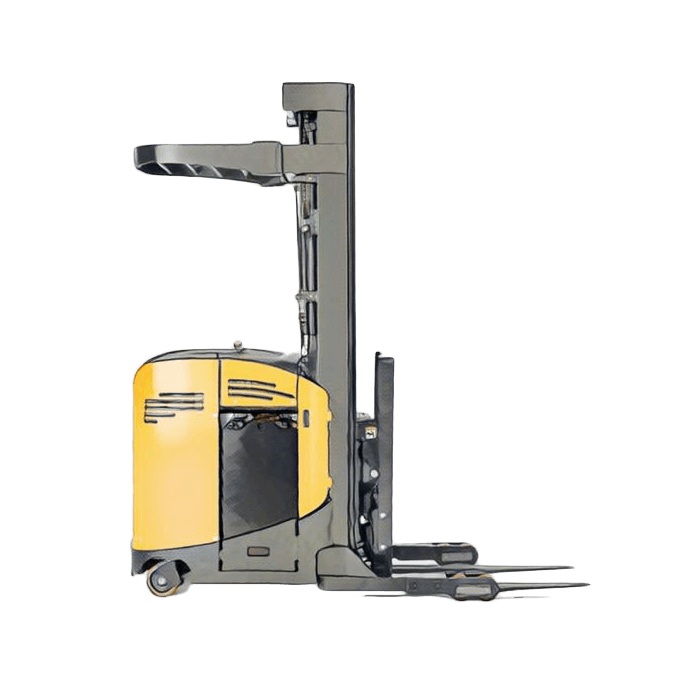
A reach forklift (also called a reach truck) is an electric narrow-aisle warehouse machine designed to lift pallets into high racking using an extending mast or fork carriage that reaches forward into the rack face — without the whole machine needing to enter the aisle. This extending reach mechanism is what separates reach forklifts from counterbalance forklifts and allows them to operate in aisles as narrow as 2.3m while accessing racking heights of 6m to 13m or beyond.
Australian distribution centres and third-party logistics operators are accelerating investment in reach forklifts as warehousing costs rise and available footprint tightens. Converting from counterbalance to reach truck operations can increase usable storage density by 30–50% on the same floor area — a significant commercial outcome in NSW and VIC markets where industrial lease rates have climbed sharply since 2022. If you're a warehouse manager or procurement lead evaluating reach forklifts for the first time or replacing an ageing fleet, this guide walks you through type selection, key specifications, 2026 Australian pricing and what to ask suppliers. Browse verified Australian reach forklift suppliers on IndustrySearch to compare models alongside this guide.
Reach forklifts are the standard choice across:
- Distribution centres and third-party logistics operations
- Retail and e-commerce fulfilment warehouses
- Food and beverage storage with high-bay racking
- Cold store operations requiring narrow-aisle access
- Manufacturing facilities with internal parts or raw material storage
- Pharmaceutical and healthcare logistics requiring indoor, zero-emission equipment
Choose your reach forklift type
Before costing anything, confirm which configuration suits your warehouse. Your choice here sets your price bracket, aisle width requirements and most of the specs that follow.
Type | Lift Height | Key Feature | Best For |
|---|---|---|---|
Single-deep reach truck |
6m–10m |
Standard pantograph reach, stand-on or sit-down |
General warehousing, single-deep racking, most Australian operations |
Double-deep reach truck |
8m–11m |
Extended pantograph reaches two pallet positions deep |
High-density storage where FIFO rotation is less critical |
High-reach / VNA truck |
10m–13m+ |
Camera systems, wire or rail guidance common |
High-bay warehouses, cold stores, operations maximising cubic storage |
Sit-down reach truck |
6m–10m |
Seated operator position, wider aisle requirement |
Operators on extended shifts, mixed-task environments |
Choose a single-deep stand-on reach truck for most standard Australian warehouse applications — it covers the widest range of racking configurations, fits aisles from 2.5m, and represents the strongest value at the mid-range price point. Choose a double-deep or high-reach model only when your racking layout and storage density targets genuinely require it; these machines cost more, demand flatter floors and in some cases require guidance systems that add to the project cost. Once you've confirmed your type, move to Step 2.
Evaluate the key specifications
With your reach truck type confirmed, these are the specs that determine whether a given model actually fits your warehouse and racking configuration.
Specification | Typical Range | Buyer Consideration |
|---|---|---|
Rated lift capacity |
1,000kg–2,500kg |
Always verify rated capacity at your maximum lift height — capacity reduces significantly at height |
Maximum lift height |
6m–13m+ |
Must reach your top beam level with clearance — add 200–300mm buffer above top beam |
Aisle width (AST) |
2.3m–2.8m |
Confirm against your current aisle layout before specifying — double-deep trucks need wider aisles |
Reach stroke |
550mm–1,100mm |
Must cover your rack depth plus clearance; double-deep requires extended stroke |
Travel speed (loaded) |
8–12 km/h |
Higher speed improves cycle times in longer aisles — relevant for large distribution centres |
Lift speed (loaded) |
0.4–0.6 m/s |
Directly affects picks per hour — critical for high-throughput operations |
Battery voltage / capacity |
48V–80V / 400–1,000Ah |
Higher voltage suits heavy lift applications; capacity determines runtime per shift |
Mast type |
Duplex, triplex, free-lift |
Free-lift mast allows load movement without raising the outer mast — required in low-clearance areas |
Floor flatness requirement |
FM2 standard for 10m+ |
High-reach trucks require superflat floors — assess your slab before specifying machines above 10m |
Understand the full cost breakdown (2026 prices)
Purchase price is only part of the picture — most cost models that get rejected at approval stage have missed the running cost layer. Here's the full breakdown for 2026 Australian market conditions.
Category | Price Range (AUD) | Typical Configuration |
|---|---|---|
Entry-level new |
$25,000–$40,000 |
Single-deep, stand-on, lead-acid battery, 6–8m lift height |
Mid-range new |
$40,000–$60,000 |
Single-deep, 8–10m lift, lithium-ion option, camera system |
High-spec new |
$60,000–$75,000+ |
Double-deep or high-reach, 10m–13m+, lithium-ion, integrated camera and telematics |
Used / refurbished |
$12,000–$35,000 |
Verify battery health, mast condition and hours before purchase |
Annual maintenance |
$3,500–$8,000 |
Higher for multi-shift operations and machines above 10m lift height |
Battery replacement (lead-acid) |
$4,000–$8,000 |
Every 3–5 years depending on charge cycles and maintenance |
Battery replacement (lithium-ion) |
$8,000–$15,000 |
Every 5–8 years; opportunity charging reduces degradation |
Pricing reflects 2026 landed cost including standard commissioning. A mid-range reach truck running a single shift will typically require servicing every 500–1,000 operating hours at $1,500–$3,000 per service, plus battery replacement at the 4–5 year mark. Multi-shift operations with lead-acid batteries should also budget for a spare battery ($4,000–$8,000) to maintain productivity during charging cycles. For guidance on battery runtime and shift planning, see the IndustrySearch electric forklift battery guide. For broader electric forklift comparisons, browse electric forklifts on IndustrySearch.
Plan the asset — depreciation and financing
Reach forklifts are classified as materials handling plant and equipment for ATO depreciation purposes. The effective life is generally 10–12 years, giving a diminishing value depreciation rate of 20% per year, or 10% under the prime cost method. Confirm the current instant asset write-off threshold with your accountant before finalising your approval — this changes annually and can materially affect the year-one tax position on a $40,000–$75,000 asset.
Residual value for well-maintained reach trucks sits at 15–25% of purchase price at the 8–10 year mark, with lithium-ion equipped machines holding value better in the Australian used market. For operations where volume or racking configuration may change, short-term hire and operating lease options are available from most major suppliers on 12–60 month terms — a practical alternative to capital purchase when the warehouse layout is still being optimised.
Evaluate suppliers
You're ready to go to market. Use this checklist to assess each supplier against the same criteria.
Factor | What to Ask |
|---|---|
Rated capacity at height |
What is the rated capacity at my maximum lift height — not just at ground level? |
Aisle width confirmation |
Can you confirm this model will operate in my current aisle width with a site measurement? |
Floor flatness |
What floor flatness standard does this machine require, and will you assess my slab? |
Battery type and runtime |
What runtime does this battery deliver at my expected lift height and cycle frequency? |
Charging infrastructure |
What charger is included, and is my existing power supply adequate? |
Camera and visibility aids |
Is a height camera standard or optional at my specified lift height? |
Local service coverage |
Do you have service technicians based in my state, or is support contracted out? |
Spare parts availability |
Are mast components, reach mechanisms and electrical parts stocked locally? |
Operator training |
Is LF class licence training available through you or a recommended RTO? |
Warranty terms |
Does the warranty cover mast, reach mechanism and battery, or machine chassis only? |
Hire and lease options |
Do you offer short-term hire or operating lease, and on what terms? |
Frequently asked questions
How much does a reach forklift cost in Australia in 2026?
New reach forklifts range from $25,000–$40,000 for entry-level single-deep models to $60,000–$75,000+ for high-reach or double-deep configurations with lithium-ion batteries. Used machines are available from $12,000 but require independent assessment of battery health and mast condition before purchase.
What is the difference between a reach forklift and a counterbalance forklift?
A reach forklift extends its forks forward into the rack without moving the machine body, allowing it to operate in aisles as narrow as 2.3m and reach heights of 13m+. A counterbalance forklift carries the load in front of the machine and requires wider aisles — typically 3.5m or more — but can operate outdoors and handle heavier loads.
What licence is required to operate a reach forklift in Australia?
An LF class High Risk Work Licence (HRWL) is required under the WHS Act 2011 to operate any forklift in Australia, including reach trucks. Confirm specific requirements with your state WHS regulator, as some jurisdictions have additional conditions for machines operating above certain heights.
How high can a reach forklift lift?
Standard single-deep reach trucks lift to 6m–10m; high-reach and VNA models extend to 13m or beyond with appropriate guidance systems and superflat floors. Always verify your model's rated capacity at your maximum lift height — capacity reduces as height increases.
What floor condition does a reach forklift require?
Machines operating below 10m generally require a standard warehouse slab in good condition. High-reach trucks operating above 10m typically require an FM2 superflat floor standard — assess your existing slab before specifying these machines, as remediation can add significant project cost.
Should i choose lead-acid or lithium-ion battery?
Lead-acid is the lower upfront cost and suits single-shift operations with overnight charging; lithium-ion charges in 1–2 hours, supports opportunity charging during breaks, and suits multi-shift or high-intensity environments. Over a 5–8 year period, lithium-ion's lower maintenance and longer lifespan often offsets the higher purchase price.
Summary
- Reach forklifts suit narrow-aisle warehouses from 2.3m — converting from counterbalance can increase storage density by 30–50% on the same floor area
- Single-deep stand-on models cover most Australian warehouse applications at $25,000–$60,000 new
- Always verify rated capacity at your maximum lift height — it reduces significantly above 8m
- High-reach models above 10m require superflat floors — assess your slab before committing
- Lithium-ion suits multi-shift operations; lead-acid remains viable for single-shift with overnight charging
- LF class HRWL is required for all operators — confirm training availability with your supplier before purchase
Ready to source your reach forklift?
Don't waste time contacting suppliers individually. IndustrySearch gives you direct access to verified Australian reach forklift suppliers — compare models, specs and pricing in one place, then request quotes from suppliers best matched to your operation.
- Compare models — filter by lift height, capacity and region
- Request quotes — contact multiple verified suppliers with a single enquiry
- Contact suppliers directly — speak to specialists who service your state

-160x160-state_article-rel-cat.png)




-160x160-state_article-rel-cat.png)