
Key takeaways
- What they cost: Monorail cranes on IndustrySearch typically range from around $15,000 to $25,000, averaging near $20,000, with larger spans and capacities running higher.
- What sets the price: Lifting capacity, beam length and path, manual versus motorised trolley, hoist type, and installation are the main cost drivers.
- Where they fit: Moving loads repeatedly along a fixed line, such as a production line, machine-to-machine transfer, or loading bay, where a full bridge crane is more than you need.
- The compliance point: Design, manufacture, and installation must meet AS 1418.1, with annual competent-person inspection under AS 2550.1.
- The decision: Match capacity and beam path to your workflow, choose manual or motorised for your duty, and budget installation on top of the crane price.
When your lifting happens along a single, repeatable path rather than across a whole bay, a monorail crane is often the most cost-effective answer. A hoist and trolley travel along a fixed beam, carrying loads from point to point without the cost or complexity of a full overhead bridge crane. This guide covers what monorail cranes cost in Australia in 2026, the specs that shape the price, and how to match a system to your site before you request quotes.
Why a monorail over a bridge crane
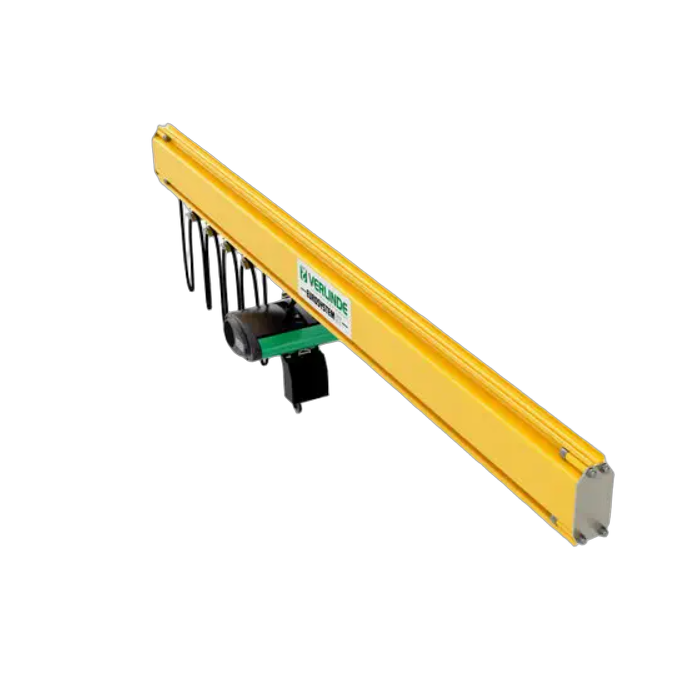
The case is fit and cost. A monorail crane carries a hoist along a single beam that follows a defined path, straight or curved, so it suits repetitive transfer along a line: feeding a machine, moving parts between workstations, or loading a bay. A full overhead bridge crane covers an entire rectangular area but costs far more and is overkill where the work follows one line.
The productivity and safety case is the same as for other lifting equipment: it removes manual handling of heavy loads, and body stressing remains one of the largest categories of serious workers' compensation claims according to Safe Work Australia. A monorail lets one operator position a heavy load precisely along the path with minimal effort.
What a monorail crane costs in 2026
Price tracks capacity, beam length, and drive type. As a working guide for the Australian market:
- Light-duty systems: Roughly $15,000 to $18,000. Lower capacities with a manual push trolley over a short, straight beam.
- Mid-range systems: Around $18,000 to $22,000. Motorised trolley options, longer beams, and electric hoists for regular duty.
- Higher-capacity and custom systems: $22,000 to $25,000+. Higher safe working loads, curved or longer paths, and heavier-duty hoists. Large custom installations run well beyond this.
Configuration shifts the total: a motorised rather than manual trolley, a longer or non-linear beam path, a higher-capacity hoist, and pendant or radio control all add to the price tag. Because monorail systems are often custom-designed to a site, it pays to compare monorail crane quotes from Australian suppliers against your capacity and beam path. For applications that span a whole bay rather than a line, weigh it against an overhead crane or a gantry crane instead.
| System class | Trolley | Indicative price | Best fit |
|---|---|---|---|
| Light-duty | Manual push | $15,000 - $18,000 | Short straight path, lighter loads |
| Mid-range | Motorised | $18,000 - $22,000 | Regular duty, longer beams |
| Higher-capacity / custom | Motorised | $22,000 - $25,000+ | Heavier loads, curved paths |
The specs that shape the price
When you request quotes, these are the numbers that change the total:
- Lifting capacity: Monorail systems commonly run from 250kg up to around 10 tonnes. Size to your heaviest routine load plus a safe margin, not the occasional outlier.
- Beam length and path: The beam sets how far the hoist travels. A straight run is cheapest; curved or branched paths for non-linear transfer add engineering and cost.
- Manual or motorised trolley: A manual push trolley suits lighter, lower-frequency work; a motorised trolley suits heavier loads and frequent travel, and costs more.
- Hoist type: Electric chain or wire-rope hoists differ in capacity, lift height, and speed. Match the hoist to your load and cycle.
- Control: Pendant control is standard; radio control adds flexibility and cost, letting the operator stand clear of the load.
Reading the total cost, not just the price tag
The crane price is only part of the picture. Monorail systems are usually designed, manufactured, and installed to suit the site, so budget for the supporting structure, installation, and commissioning on top of the equipment. The beam must be supported correctly, and the installation must comply with AS 1418.1. Ongoing, an annual competent-person inspection under AS 2550.1 is mandatory, along with routine maintenance and inspection of slings, hooks, and lifting gear. Weigh those against the manual handling the crane removes, which is where the return sits. For the compliance framework and how to evaluate suppliers on installed cost, the jib crane buying guide works through the AS 1418 and AS 2550.1 duties that apply to monorail systems too.
A realistic scenario
Picture a Sydney engineering workshop moving heavy fabricated parts from a welding bay to a finishing station along the same line all day, currently using a forklift that ties up an operator and blocks the aisle.
A mid-range monorail crane with a motorised trolley and a 2-tonne electric hoist, at around $21,000 for the equipment plus installation, carries each part straight from weld to finish along a fixed beam. One operator positions the load precisely, the forklift is freed for other work, and the manual handling risk is removed. It does not cover the whole workshop the way a bridge crane would; it does one repeated transfer efficiently and safely for a fraction of the cost.
Frequently asked questions
How is a monorail crane different from an overhead bridge crane?
A monorail carries a hoist along a single fixed beam on a defined path, ideal for point-to-point transfer. A bridge crane spans two runways and covers a whole rectangular area. Choose a monorail when your lifting follows one line, and a bridge crane when it spans a bay.
Can the beam follow a curved path?
Yes. Monorail systems can be designed for linear or non-linear paths, including curves and branches, so the hoist can follow your workflow. Curved and branched paths add engineering and cost over a straight run.
Do I need a licence to operate one?
Operating requirements depend on the configuration and your state's rules. Regardless of licensing, operators must be trained and competent, and the system needs annual competent-person inspection under AS 2550.1. Confirm current requirements with your WHS regulator.
What does installation involve?
The beam must be supported by suitable structure and installed to AS 1418.1, then commissioned before use. Installation cost varies with your building and the beam path, so ask suppliers for installed pricing, not just the equipment price.
What matters most
A monorail crane is the right call when your lifting follows a single repeatable path and a full bridge crane would be overkill. Anchor your choice to capacity and beam path, choose manual or motorised trolley for your duty, and budget installation and ongoing inspection alongside the equipment. Get the fit right and it removes manual handling and speeds transfer for years. Get it wrong and you either overspend on a bridge crane you did not need or undersize a system that cannot handle your loads.
Ready to compare capacities, beam paths, and pricing on monorail crane systems? Get quotes from monorail crane suppliers across Australia here.