
Key takeaways
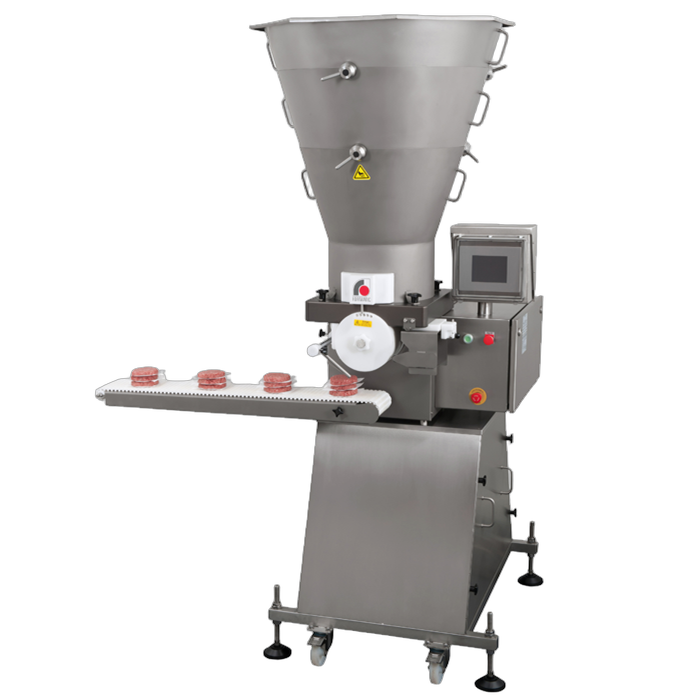
Rotary drum formers suit patties, nuggets and cookies at small to high volume: the Formatic range is listed at about 1,000 to 24,000 products an hour, with the top figure for the wider C-series, and hoppers from 15 to 75 kg. Actual output depends on product size and weight.
Mould-plate formers suit high-volume patty production on dedicated lines: a used Bridge model 240 is rated at about 21,600 patties an hour.
Encrusting and co-extrusion machines wrap one mix around another, for arancini, filled croquettes, filled meatballs and similar products; ball formers suit plain meatballs.
Coating is often a sequence, not a single machine: commonly predust, then batter or tempura, then crumb or flour, although some recipes and coating systems skip the predust. Drum breaders give a home-style finish; flatbed crumb breaders coat evenly on all sides.
Engineer transfers and throughput across the line: machines with different belt widths can work together when transfers are designed for it, but every stage must handle the line's rate, so size the line to its slowest step, usually the fryer, oven or freezer.
According to the Australian Chicken Meat Federation, citing ABARES data for the December quarter 2025, Australians eat almost 55 kg of chicken meat a year on average, and nearly 70% of households serve it at least twice a week. Formed and coated chicken, beef, seafood and plant-based products are a large and competitive market. Choosing the right equipment comes down to four questions: what shape and texture you need, how many an hour, which coating, and what happens next. This guide compares the main forming technologies and coating systems.
Forming technologies compared
Technology | How it works | Best for | Watch-outs |
|---|---|---|---|
Manual or pneumatic press | Operator loads a mould and presses each portion | Butchers and small kitchens | Labour-intensive; output limited by the operator |
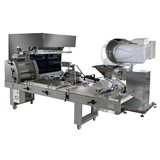
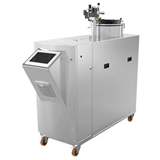
Rotary drum former | Mix is pressed into cavities in a rotating drum and released onto a belt | Patties, nuggets, fish cakes, cookies; small to high volume | Each shape needs its own drum; texture depends on mix and fill pressure |
Mould-plate former | A reciprocating plate fills with mix, then knockout cups release the portion | High-volume patty and nugget lines | Larger investment; plate changes for each product |
Ball former | Mix is portioned and rolled into spheres | Meatballs, falafel, arancini without filling | Limited to round shapes |
Encrusting or co-extrusion machine | An outer mix is wrapped around a filling and cut | Filled arancini, croquettes, kibbeh, filled meatballs, mochi | Higher price; recipe development needed for each product |
Portioner or depositor | Doses a set weight of mix or filling | Sausages, fillings, gram-exact portions | Shaping often needs a second step |
Examples on IndustrySearch show the spread. The alco former from JBT portions raw mixtures to the gram into interchangeable plate shapes. Symetec supplies both Rheon encrusting machines, used for products from meat and seafood to confectionery and arancini, and Traymatic formers that place products straight onto trays instead of hand traying.
Output, handling and tooling
Output: Symetec's listing rates the Formatic R-series at about 1,000 to 8,800 shapes an hour and the wider C-series at up to about 24,000; real output depends on product size and weight. High-volume mould-plate formers such as the Former Associates FA-2600 are rated at up to 9,000 lb (about 4,080 kg) an hour.
After forming: paper interleaving, stacking and traying reduce handling. Formatic's S2000 stacker builds stacks up to 100 mm tall.
Tooling: budget for a drum, plate or nozzle set for each shape. Some machines change portion weight or thickness by adjustment rather than new tooling, so ask what each product change requires and how long it takes.
Mix temperature and texture: fat content, particle size and temperature change how cleanly a product fills and releases. Run trials with your own mix before you buy.
Coating systems: predust, batter and breading
Coating often runs in up to three stages, handled by separate machines or a combined system.
Predust: a dry flour or powder layer that helps batter stick, used in many but not all coating recipes. JBT's alco preduster applies flour, powder, fine spices or sugar.
Batter or wet coating: a liquid layer applied by cascade, dip or tempura bath. Thicker tempura batters need different applicators from thin adhesion batters.
Breading: crumb or flour applied on top. Systems such as Proquip's HiTec cover the full sequence: flour or predust, wetcoat, tempura dip and crumb breading.
Breader design changes the finish:
Breader type | How it works | Finish | Typical products |
|---|---|---|---|
Flatbed or conveyor crumb breader | Products travel on a bed of crumbs with a top curtain, and a blower removes the excess | Even coating on all sides | Schnitzels, cutlets, crumbed fillets, cheese sticks |
Drum breader | Products tumble in a rotating drum of breading | Irregular, home-style coating | Home-style chicken, uneven pieces |
Dedicated crumb coater | Built for coarse or panko crumb with gentle recirculation | Consistent crumb without breaking it down | Nuggets, croquettes, crumbed seafood |
GEA's range on IndustrySearch shows the split: the CrumbMaster is a dedicated crumb coater, while the MultiDrum recreates home-style breading on an industrial scale. JBT's Stein 5-Star applies a home-style coating to products with uneven surfaces.
Note that meat massagers and tumblers, such as JBT's Schroder MAX range, marinate meat before forming or coating. They are not coating machines, although they are sometimes listed alongside them.
Building a complete line
A typical coated product line runs: mince preparation, forming, predust, batter, breading, then flash frying, cooking, chilling or freezing, and packing. One example combines an alco/JBT AFM 400 former, ASC 400 wet breading machine and APN 400 breading machine, followed by frying and freezing.
When you build in stages:
engineer the transfers between machines: matching belt widths simplifies this, with 400 mm and 600 mm common for formers and breaders, but different widths can work when transfers and throughput are designed for it
size every machine to the slowest downstream stage, usually the fryer, oven or freezer
leave space and services for the next module so you can add it later
plan allergen changeovers and cleaning access between machines (see [Article 2: Making Formed and Crumbed Foods in Australia])
Questions to ask every supplier
What output do you guarantee at our product weight, shape and mix temperature?
Can we run a trial with our own mix and coating?
What does each extra mould plate, drum or nozzle set cost, and how long is a changeover?
How is crumb or batter recirculated, filtered and emptied between products?
Which wear parts are stocked in Australia, and what is the service response time?
Compare suppliers: request quotes from food forming and coating machine suppliers on IndustrySearch with your product list, target output and coating sequence. For budget ranges, see [Article 1: Food Forming and Coating Machine Cost in Australia].
Frequently asked questions
What is the difference between a drum former and a mould-plate former?
A drum former fills cavities in a rotating drum and releases portions continuously; a mould-plate former fills a reciprocating plate and knocks portions out each stroke. Drum formers suit a wider range of volumes; mould-plate formers are common on dedicated high-volume patty lines.
What machine makes arancini or filled croquettes?
An encrusting or co-extrusion machine, which wraps an outer mix around a filling and cuts each portion.
How many patties an hour can a burger machine make?
From about 1,000 an hour on entry-level drum formers to about 24,000 on wide-drum models, and more on industrial mould-plate lines.
Do I need a preduster before battering?
Often, but not always. A dry predust layer helps many batters adhere and improves coverage, but some recipes and coating systems work without it, so trial your product.
What is the difference between a drum breader and a flatbed breader?
A drum breader tumbles products for an irregular, home-style coating; a flatbed breader coats evenly on all sides for a uniform finish.