Key Takeaways
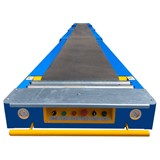
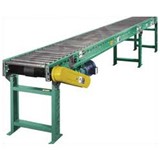
- Product compatibility: Belt conveyors handle loose items, bags, irregular shapes and inclines up to 20°; roller conveyors require rigid, flat-bottomed loads (cartons, totes, pallets).
- Purchase price: Roller conveyor costs $3,000-$25,000 per 10-30m section vs belt at $5,000-$40,000 for equivalent length - roller is 30-40% cheaper for flat, straight runs.
- Energy cost: Gravity roller sections use zero energy; powered belt systems draw 0.37-7.5 kW per drive motor continuously during operation.
- Maintenance profile: Belt systems need belt replacement every 3-7 years ($1,500-$8,000); roller systems typically need individual roller replacement at 5-10%/year ($20-$80 per roller) but no single high-cost event.
- Food-grade suitability: Belt conveyors with PU or modular plastic belts are standard for food processing; roller systems are used in food packaging and dispatch but not for direct product contact.
- Decision threshold: If your product is rigid and flat-bottomed, roller is cheaper and simpler. If your product is loose, irregular, bagged or needs incline transport, belt is typically the only viable option.
- Both belt and roller conveyors are available from verified Australian suppliers - belt conveyors and roller conveyors on IndustrySearch.
Belt Conveyor vs Roller Conveyor: Which System Fits Your Operation? (2026 Comparison)
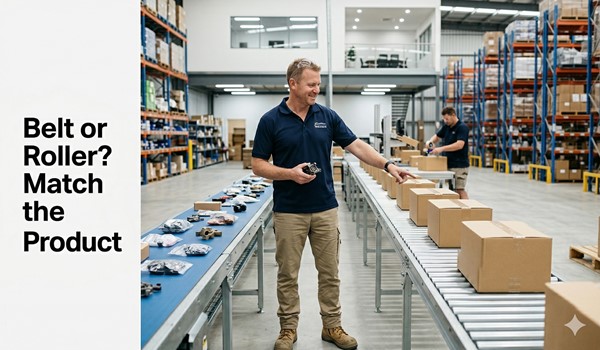
Belt and roller conveyors solve different handling problems, but the wrong choice shows up in two ways: a belt conveyor moving cartons on a flat run where gravity rollers would cost nothing to operate, or a roller system dropping small items through the gaps because the product was never suited to rollers in the first place. The decision should be made on product type and handling profile, not conveyor price.
This comparison guide puts both types side by side on capability, cost, maintenance and the decision factors that matter at procurement stage. To compare system pricing, get quotes for conveyor systems on IndustrySearch.
Operations where this comparison matters most:
- Warehouses and distribution centres handling cartons, totes and pallets on flat floor layouts
- Food processing facilities moving raw product (belt) and finished packaged goods (roller)
- Manufacturing lines integrating conveyors between workstations, packing and dispatch
- 3PL operations handling mixed product types across multiple client contracts
Step 1: Compare the Core Differences
Before comparing costs, confirm which conveyor type suits your product and handling environment. The table below covers the capabilities that drive the decision.
| Factor | Belt Conveyor | Roller Conveyor |
|---|---|---|
| Product type | Any - loose items, bags, irregular shapes, small components | Rigid, flat-bottomed only - cartons, totes, pallets, crates |
| Incline capability | Up to 20° with cleated or textured belt | Flat or slight decline only - products require control to prevent slide on incline |
| Energy (flat section) | 0.37-7.5 kW per drive - typically powered during operation | Gravity sections: zero; powered sections: 0.18-2.2 kW per zone |
| Food-grade suitability | PU and modular plastic belts for direct product contact | Stainless steel rollers for packaged food dispatch - not direct contact |
| Accumulation | Requires zone controls and sensors | Gravity accumulation is simple and zero-energy on roller systems |
| Noise | Low - belt runs quietly | Higher - rigid items on steel rollers generate noise at speed |
Step 2: Evaluate the Key Specifications
With the core differences clear, these are the specifications that determine which type delivers better value for your specific operation.
| Specification | Typical Range | Buyer Consideration |
|---|---|---|
| Load weight per metre | Belt: 10-150 kg/m; Roller: 15-500+ kg/m | Heavy-duty roller systems handle pallets and heavy cartons that would stall or damage light belt systems |
| Speed | Belt: 0.1-2.5 m/s; Roller: 0.1-1.5 m/s (powered) | Belt offers higher top speed for sortation and high-throughput lines |
| Minimum product size | Belt: no minimum; Roller: must span 3 rollers | Items smaller than 3x roller pitch fall through gaps on roller systems - belt is the only option |
| Curves and merges | Belt: requires curved belt or transfer plate; Roller: tapered rollers handle curves natively | Roller curves are generally simpler and cheaper than curved belt sections for right-angle and 90° turns |
| Modularity | Both available in modular sections | Roller sections are easier to reconfigure and extend because each section is independent |
Step 3: Compare the Full Cost (2026 Prices)
Purchase price is only part of the picture. The table below models the full 5-year cost at equivalent system length.
| Category | Belt Conveyor (30m) | Roller Conveyor (30m) |
|---|---|---|
| Purchase (new, standard) | $15,000-$40,000 | $8,000-$25,000 |
| Installation | $3,000-$8,000 | $2,000-$5,000 |
| Annual energy cost | $800-$2,500 | $0-$1,200 (gravity sections free; powered zones lower draw) |
| Annual maintenance | $1,500-$3,500 | $800-$2,000 |
| 5-year TCO | $30,000-$70,000 | $14,000-$41,000 |
At equivalent 30m length on flat runs with rigid cartons, roller conveyor costs 40-50% less over 5 years. The gap narrows when belt is required for inclines, loose products or food-grade contact. For a belt conveyor at $15,000-$40,000, get quotes for belt conveyors or for roller systems at $8,000-$25,000, get quotes for roller conveyors from verified Australian suppliers.
Step 4: Decision Framework - Belt vs Roller
| Decision Factor | Choose Belt | Choose Roller |
|---|---|---|
| Product type | Loose, bagged, irregular, small or soft items | Rigid, flat-bottomed cartons, totes, pallets or crates |
| Layout includes inclines | Yes - belt handles inclines up to 20° | No - roller suits flat or slight decline only |
| Food processing | Direct product contact - PU or modular belt required | Packaged goods dispatch only - not suitable for direct food contact |
| Energy cost priority | Belt always draws power - higher energy cost | Gravity sections cost nothing to run - lowest energy option |
| Reconfiguration | Less flexible - belt length changes require splicing or replacement | Modular - add, remove or rearrange sections without affecting the whole system |
| Budget | Higher purchase and running cost | 30-40% lower purchase cost and lower running cost on flat runs |
Step 5: Evaluate Suppliers
You are ready to go to market. Use this checklist to assess each supplier against the same criteria.
| Factor | What to Ask |
|---|---|
| Product suitability | Have you tested this conveyor type with products matching my weight, size and surface? |
| Belt or roller material | What material options suit my product and environment (PVC, PU, modular, steel, PVC roller)? |
| Throughput | What is the rated throughput at my product weight and target speed? |
| Spare parts | Are replacement belts, rollers and drive components stocked in Australia? |
| Warranty | What is covered and for how long? Is belt wear or roller attrition treated as a consumable? |
| Maintenance contract | Do you offer preventive maintenance contracts? What is included? |
| Integration | Can this system integrate with my existing sortation, packing or palletising equipment? |
| Expansion | Can sections be added later without replacing the existing system? |
| Safety compliance | Does this system meet AS 4024 including guarding, E-stops and nip point protection? |
| Lead time | What is the current lead time for standard and custom configurations? |
Frequently Asked Questions
When should I choose a belt conveyor over a roller conveyor?
Choose belt when your product is loose, bagged, irregular-shaped or smaller than 3x roller pitch. Belt is generally preferred for steeper inclines, while roller systems are typically limited to shallow inclines with control measures.
How much cheaper is a roller conveyor to run than a belt conveyor?
Gravity roller sections cost nothing to operate. Even powered roller zones typically draw 50-70% less energy than belt systems of equivalent length because only active zones consume power. Over 5 years on a 30m flat run, roller saves $4,000-$10,000 in energy and maintenance combined.
Can I use both belt and roller conveyors in the same system?
Yes - hybrid systems are common. A typical layout uses belt for product infeed, inclines and workstation transfers, then transitions to roller for accumulation, sortation and dispatch. Transfer plates or pop-up transfers connect the two types.
What is the maintenance difference between belt and roller systems?
Belt systems have one large maintenance event (belt replacement at $1,500-$8,000 every 3-7 years) plus ongoing tracking and tensioning. Roller systems have no single large event but steady roller attrition at $20-$80 per roller for 5-10% of rollers annually.
What compliance standards apply to conveyor systems in Australia?
Both types must comply with AS 4024 (Safety of Machinery) covering guarding, emergency stops and nip point protection. Food-grade belt conveyors must also meet FSANZ-aligned hygiene design standards for product-contact surfaces. A plant risk assessment under WHS Regulations 2017 is required for all fixed conveyor installations.
Summary
- Product type decides the conveyor type - loose or irregular items need belt; rigid flat-bottomed items suit roller
- Roller conveyor costs 30-40% less to buy and 40-50% less over 5 years on flat runs with cartons
- Gravity roller sections use zero energy - the lowest operating cost in any conveyor category
- Belt is the only option for inclines, small items and food-grade direct product contact
- Hybrid systems using both types are common and often the best-value solution for mixed operations
- Roller sections are easier to reconfigure and extend without affecting the rest of the system
Don't waste time contacting suppliers individually. IndustrySearch gives you direct access to verified Australian conveyor system suppliers - where industrial buyers request and compare multiple quotes so they can buy with confidence.
- Get quotes for belt conveyors - contact multiple verified suppliers with a single enquiry
- Get quotes for roller conveyors - compare pricing, capacity and configuration
- Contact suppliers directly - speak to specialists who service your state
→ Get and compare conveyor system quotes now → https://www.industrysearch.com.au/buy/conveyor-system


-160x160-state_article-rel-cat.jpg)